For Black social workers, anxiety and depression are on the rise
- Escrito por Carmen Reese Foster
- Publicado en Babel
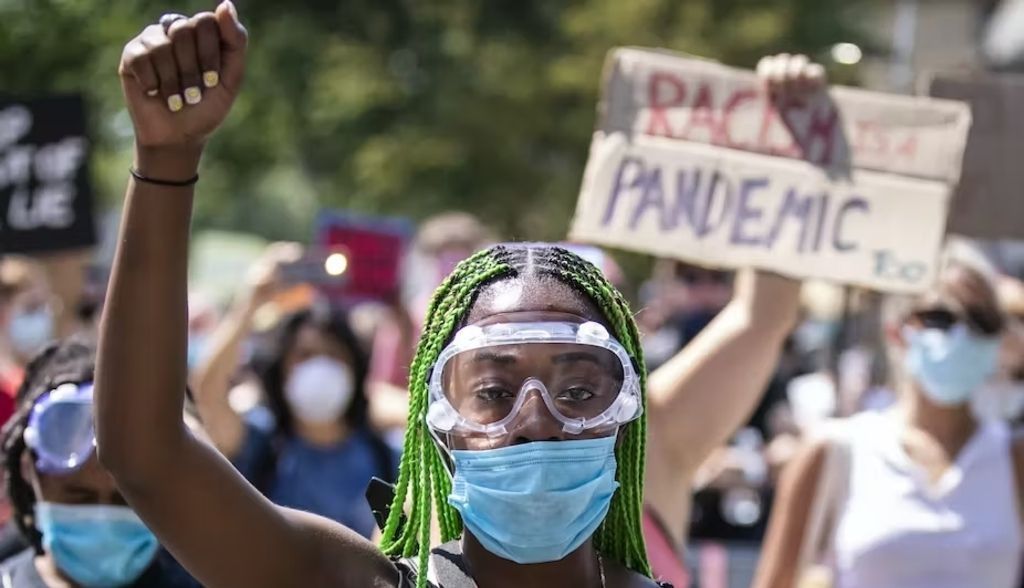 A woman raises her fist during a 2020 Black Lives Matter protest in Queens, New York. Ira L. Black/Corbis via Getty Images
When George Floyd was brutally murdered in the summer of 2020, a wave of activism spread throughout the country.
People protested. Anti-racism books became bestsellers. Diversity, equity and inclusion jobs increased by 55%, and the top 50 U.S. public companies pledged $49.5 billion to tackle racial justice issues.
At the same time of this racial reckoning, COVID-19 was disproportionately affecting communities of color in the number of cases, hospitalizations and deaths. In addition, anxiety and depression rates were rising rapidly among Black people.
As an assistant professor of practice in social work and the executive director of the nonprofit Coalition of Black Social Workers, I felt it was necessary to assess how Black social workers were affected by the COVID-19 pandemic and heightened racial tensions.
As social workers, we are trained mental health professionals who prioritize social justice.
But how do we cope when faced with the collective trauma of a global pandemic and the mental and emotional effects of racism?
A lack of empathy
My research team conducted a study to assess social workers’ symptoms of depression, anxiety, discrimination-related trauma and quality of life in response to the COVID-19 pandemic and the systemic racism that led up to 2020.
The results showed that there was a significant increase in depression and anxiety among the 113 Black social work professionals we surveyed.
Arguably, a more surprising finding was that 85% of Black social workers were deeply disappointed in the lack of empathy shown to them from their white social work colleagues.

One Black respondent discussed having a conversation with a white colleague about the racial protests and reported that the colleague was nonchalant and dismissive.
Another Black respondent recalled that their white social work supervisor did not offer any type of mental health support.
Black social workers expected compassion and empathy from their peers, but instead, their issues were met with minimization and dismissiveness. The results showed that they were disappointed and hurt by their colleagues’ lack of understanding.
The limits of diversity efforts
The inauthentic behavior of some social workers to appear supportive and engaged in social justice issues – when they are not – is known as performative allyship.
In my view, this is akin to checking items off a list for the appearance of progress when the reality is far different.
Instead of Black social workers finding genuine support at their workplaces, our research found that many reported feeling disappointed and exhausted and chose to limit their workplace interactions with their white colleagues in order to protect themselves from further pain.
Where most Black social workers found the most support for their well-being and mental health is not surprising. Throughout 2020, 95% reported that family and close friends were critical to their well-being.
The limits of mere words
Since the 2020 racial reckoning, social workers have prided ourselves on working to eliminate social justice disparities.
“Eliminating Racism,” for instance, became an official grand challenge of social work in 2020. For its part, the National Association of Social Workers published two volumes of “Undoing Racism in Social Work.” In addition, the Council of Social Work Education’s, anti-racism standards became a part of the 2022 Educational Policy and Accreditation Standards.
But as a profession, the use of terms such as anti-racism in book titles and standards alone means very little if Black social workers reported that they still feel neglected by their white colleagues.
When social work leaders are concerned more about writing statements of solidarity on social media or joining an anti-racism book club or checking another diversity box, Black social workers feel unseen, unheard and, worse, not important.
Carmen Reese Foster, Interim Online MSSW Program Director, Assistant Professor of Practice, Director of Alumni Affairs, University of Tennessee
This article is republished from The Conversation under a Creative Commons license.