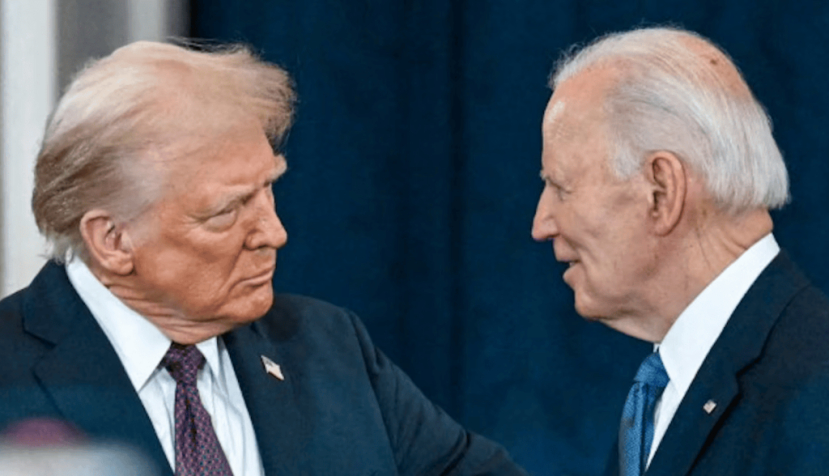
Plus de mille prisonniers politiques croupissent toujours dans les geôles d’Alexandre Loukachenko, au pouvoir sans discontinuer depuis 1994. Mais 123 d’entre eux, dont de nombreux responsables d’opposition de premier plan, viennent d’être libérés, en contrepartie de la levée de certaines sanctions américaines. Un « deal » qui s’inscrit dans le contexte plus large de l’implication de Minsk aux côtés de Moscou face à l’Ukraine.
During a press conference on Dec. 11, 2025, White House press secretary Karoline Leavitt announced there was good news on the state of the economy.
“Inflation as measured by the overall CPI has slowed to an average 2.5% pace,” she said, referring to the consumer price index. “Real wages are increasing roughly $1,200 dollars for the average worker.”
This week, after a 156-day trial, the Hong Kong pro-democracy campaigner and media tycoon Jimmy Lai was convicted of sedition and collusion with foreign or external forces.
Now facing life in prison, Lai was convicted under the country’s National Security Law, introduced in 2020.
The Jeffrey Epstein story has slipped in and out of the headlines for years, but in a very particular way. Most news articles ask a specific question – which powerful men might be on “the list”?
En Europe comme ailleurs, la montée des groupes d’extrême droite s’impose comme un phénomène majeur. Face à cette menace, les démocraties sont appelées à réagir. Parmi les réponses possibles figurent des mesures répressives, telles que l’interdiction de certains partis politiques. Mais ces stratégies sont-elles réellement efficaces ? En adoptant une perspective rétrospective sur l’histoire des démocraties européennes, il est possible d’en évaluer à la fois les forces et les limites.
Longtemps marquée par une mortalité élevée, la population de Paris accusait à la fin du XIXᵉ siècle un lourd retard d’espérance de vie par rapport à celles des autres régions de France. Un siècle plus tard, la ville est devenue l’un des territoires où l’on vit le plus longtemps au monde. Comment expliquer ce renversement spectaculaire ? Une plongée dans les archives de la capitale permet de retracer les causes de cette transformation, entre recul des maladies infectieuses, progrès de l’hygiène publique et forte baisse des inégalités sociales face à la mort.
Catalan politics are now, it seems, a far cry from 2017’s infamous, unauthorised independence referendum. It was violently repressed by national police forces, led to widespread rioting, triggered a constitutional crisis in Spain, and saw leaders like Carles Puigdemont flee the country.
Ukraine is under unprecedented pressure, not only on the battlefield but also on the domestic and diplomatic fronts.
Each of these challenges on their own would be difficult to handle for any government. But together – and given there is no obvious solution to any of the problems the country is facing – they create a near-perfect storm.
Promis depuis plus de quarante ans, le « statut de l’élu local » devrait enfin voir le jour, avec un vote en deuxième lecture à l’Assemblée nationale le lundi 8 décembre. Très attendue par les élus, cette loi révèle pourtant un paradoxe : comment donner un statut à une fonction dont les contours restent flous et dont les conditions d’exercice sont profondément inégales ? À travers ce texte se révèle le profond malaise de l’engagement politique local.
News reports about a U.S. military attack on a boat in the Caribbean allegedly carrying drugs have raised critical questions about the military campaign against drug smugglers being carried out by the Trump administration in that region.
Among them: whether Secretary of Defense Pete Hegseth or others face criminal liability for any of the attacks. Those attacks killed people alleged to have been involved in illegal narcotics trafficking.
Americans tend to look to the Constitution to assess whether the nation is living up to its founding principles when navigating major social and political issues.
But it is the declaration, signed on July 4, 1776, that declares the nation’s credo, that “all men are created equal.”
Throughout history, Americans have turned to the declaration for guidance about what the nation should stand for.
As a historian of the United States and the coordinator for the University of Richmond’s Forging a New Nation initiative, which commemorates the Declaration of Independence’s 250th anniversary, I have been thinking a lot about this phenomenon.
Particularly during times of social and political upheaval, Americans have sought out the Declaration of Independence when they wanted to remedy contemporary problems and create new visions for the country’s future. Many of the nation’s greatest leaders have praised and memorialized its rhetoric and ideas in the promotion of their own.
In his 1852 speech “What to the Slave is the Fourth of July?” Frederick Douglass, the formerly enslaved abolitionist, used the declaration to set a standard for American society. As a Black American, Douglass insisted he was “not included within the pale” who enjoyed the “inalienable rights” articulated in the declaration.
Nonetheless, the “great principles of the Declaration” gave Douglass hope and cause for optimism. He predicted that the “glorious hour” would soon arrive when all Americans would be defined “by equal birth.”
Conceived in liberty
A photo by Mathew Brady of Abraham Lincoln – center, bareheaded – giving the Gettysburg Address in 1863.Bettman/Getty Images
Abraham Lincoln denounced the decision and countered by defining a more capacious view of American freedom based on the declaration.
Lincoln told one audience that Thomas Jefferson and the signers of the declaration “set up a standard maxim for free society,” which they “intended to include all men” and to be “constantly looked to, constantly labored for.”
Their goal, Lincoln said, was “augmenting the happiness and value of life to all people of all colors everywhere.”
As civil war ravaged the country and claimed thousands of American lives, Lincoln again drew on the declaration to articulate a vision for the country as president.
The nation, he said, was undergoing a “new birth of freedom” as it waged war on slavery and defended its government against domestic rebellion.
Self-evident truth
Seventy years later, the declaration provided inspiration for President Franklin D. Roosevelt as he steered the nation through a crippling economic depression and the run-up to a world war. Roosevelt advocated for building America’s first social safety net by drawing on the declaration.
Reflecting Roosevelt’s aims, the 1936 Democratic Party platform illustrated this rhetorical strategy, borrowing from the declaration at its very beginning: “We hold this truth to be self evident – that government in a modern civilization has certain inescapable obligations to its citizens.”
During his 1944 State of the Union Address, Roosevelt said the nation was built on the rights embedded in the Declaration of Independence and the Constitution. But, he argued, “true individual freedom cannot exist without economic security and independence.”
All created equal
Amid the political and social upheaval of the 1960s, the Rev. Martin Luther King Jr. drew directly and self-consciously on the declaration.
In his 1963 “I Have a Dream” speech, King defined an America that “guaranteed unalienable rights of life, liberty and the pursuit of happiness” to its citizens.
Though the nation had “defaulted on this promissory note insofar as its citizens of color are concerned,” King said, the declaration still offered him hope: “I have a dream that one day this nation will rise up and live out the true meaning of its creed: We hold these truths to be self evident, that all men are created equal.”
With the declaration’s anniversary coming up at a time when so much about contemporary society and politics are being contested, Americans may well return once again to this founding document to define themselves as a people and a nation.
Graeme Mack, Visiting Assistant Professor of History, University of Richmond
This article is republished from The Conversation under a Creative Commons license.
In public discourse, we spend a great deal of collective energy debating the accuracy of facts. We fact-check politicians, monitor social media for misinformation, and prioritise data-driven decision-making in our workplaces. This focus is vital; the distinction between truth and falsehood is the bedrock of a functioning society.
Le président d’Israël Isaac Herzog a quelques semaines pour décider s’il gracie ou non le premier ministre Benyamin Nétanyahou, empêtré dans plusieurs affaires de corruption… pour lesquelles il n’a d’ailleurs pas encore été condamné, ce qui rend sa demande de grâce particulièrement exceptionnelle. Ce qui est en jeu ici, c’est à la fois l’avenir personnel et politique du chef du gouvernement, qui espère être reconduit à son poste aux élections de l’année prochaine, et l’indépendance du système judiciaire israélien.
Fall marks the start of Iran’s rainy season, but large parts of the country have barely seen a drop as the nation faces one of its worst droughts in decades. Several key reservoirs are nearly dry, and Tehran, the nation’s capital, is facing an impending “Day Zero” – when the city runs out of water.
Necesitamos tu apoyo económico para hacer un periodismo fiable y con valores sociales
PERIODISMO DE DATOS
El periodismo independiente necesita el apoyo de sus lectores y lectoras para garantizar que los contenidos incómodos que no quieren que leas, sigan estando a tu alcance. Si compartes estas preocupaciones y si valoras la labor de un medio libre que se atreve a plantearlas, apóyanos ahora.
PREGUNTAS FRECUENTES
¿Por qué es importante tu aportación?
Tu contribución nos permitirá seguir publicando información esencial e independiente que podrás disfrutar de forma gratuita sin muros de ningún tipo.
¿Si tengo algún problema en mi transacción?
Escribe a Esta dirección de correo electrónico está siendo protegida contra los robots de spam. Necesita tener JavaScript habilitado para poder verlo.